
Aditya Bhise’s Poster
The Impact of Patients’ Race on Clinical Judgement: A Qualitative Analysis of 100 Case Conceptualizations
by Aditya Bhise1, Jade Wei1,2, Shibani Datta2,3, Tamara Eid1,2, & Sarah Bloch-Elkouby2,3
1 Icahn School of Medicine at Mount Sinai in New York City
2 Teachers College, Columbia University in the City of New York
3 Ferkauf Graduate School of Psychology, Yeshiva University
Abstract:
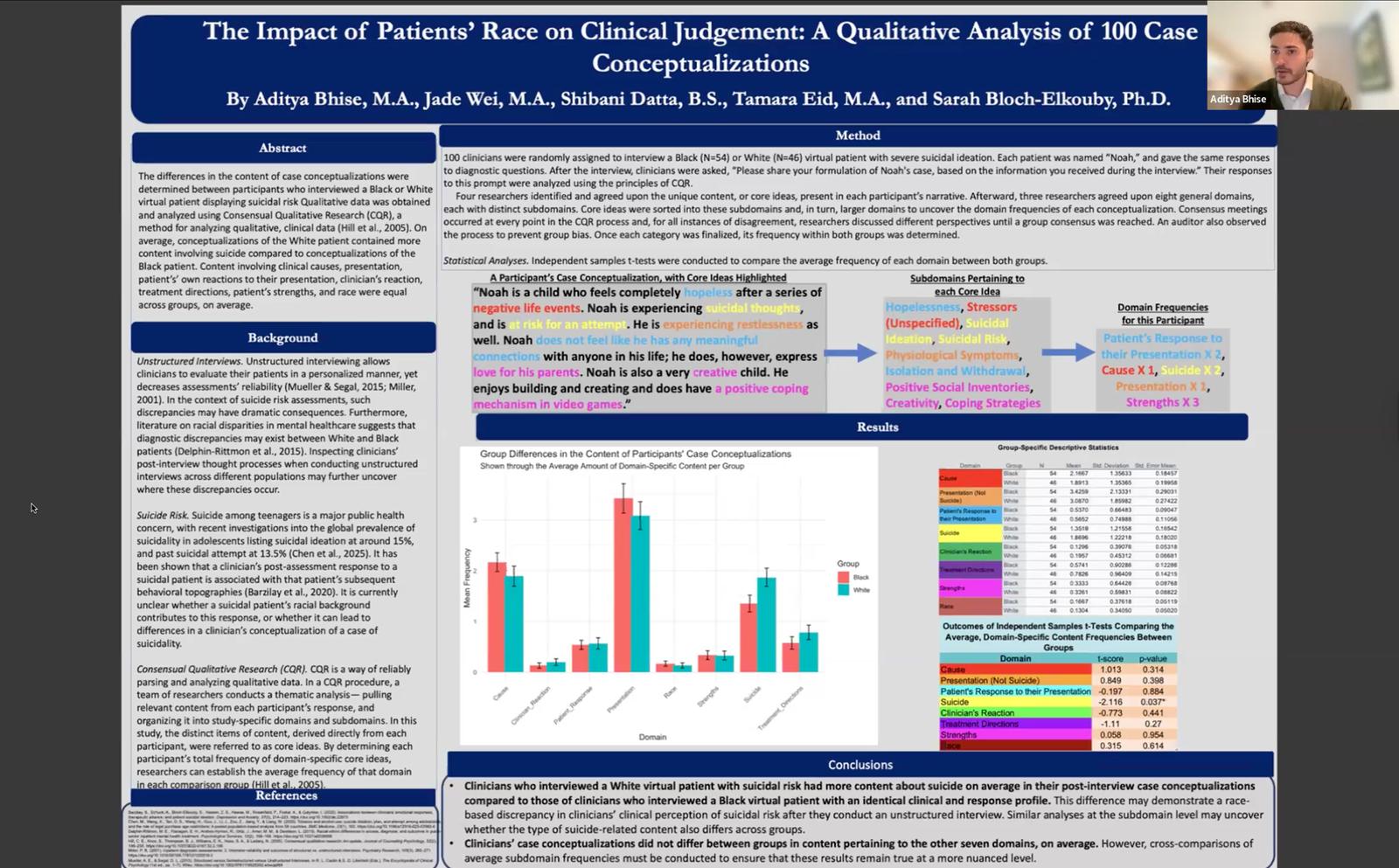
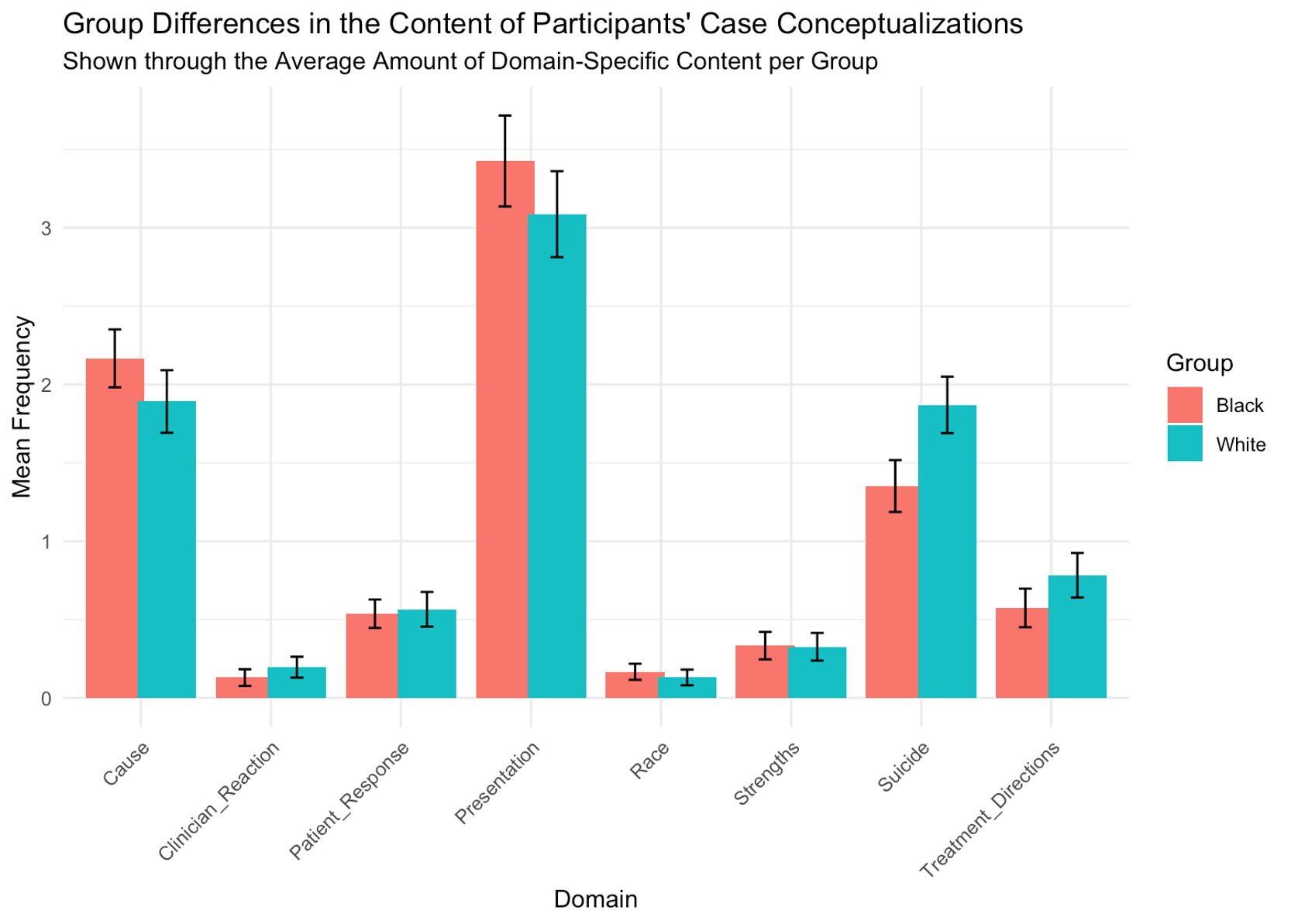
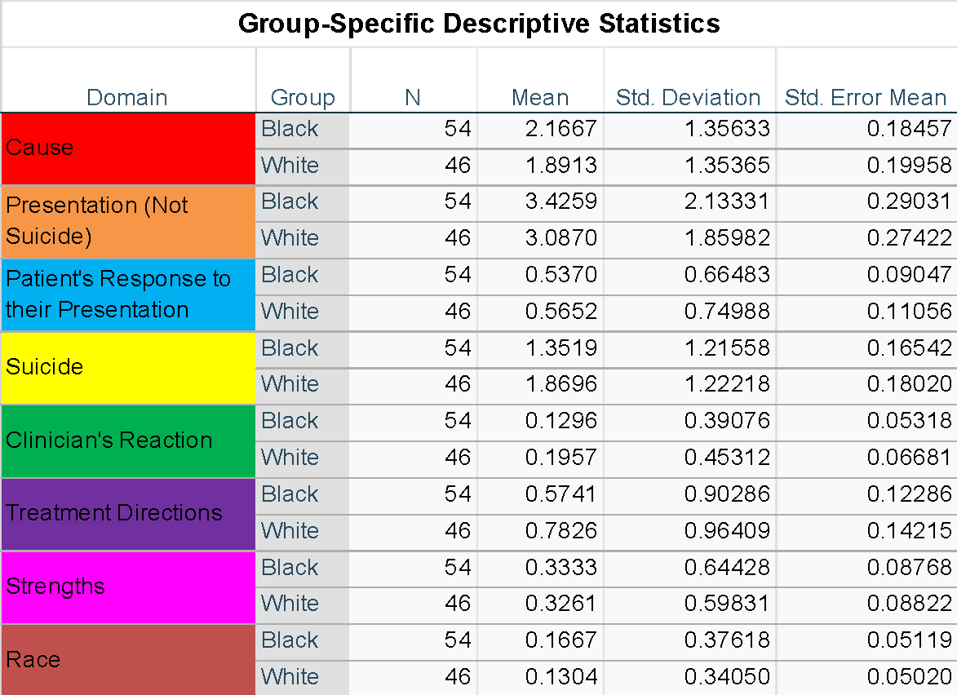
The differences in the content of case conceptualizations were determined between participants who interviewed a Black or White virtual patient displaying suicidal risk Qualitative data was obtained and analyzed using Consensual Qualitative Research (CQR), a method for analyzing qualitative, clinical data (Hill et al., 2005). On average, conceptualizations of the White patient contained more content involving suicide compared to conceptualizations of the Black patient. Content involving clinical causes, presentation, patient’s’ own reactions to their presentation, clinician’s reaction, treatment directions, patient’s strengths, and race were equal across groups, on average.
Background:
Unstructured Interviews. Unstructured interviewing allows clinicians to evaluate their patients in a personalized manner, yet decreases assessments’ reliability (Mueller & Segal, 2015; Miller, 2001). In the context of suicide risk assessments, such discrepancies may have dramatic consequences. Furthermore, literature on racial disparities in mental healthcare suggests that diagnostic discrepancies may exist between White and Black patients (Delphin-Rittmon et al., 2015). Inspecting clinicians’ post-interview thought processes when conducting unstructured interviews across different populations may further uncover where these discrepancies occur.
Suicide Risk. Suicide among teenagers is a major public health concern, with recent investigations into the global prevalence of suicidality in adolescents listing suicidal ideation at around 15%, and past suicidal attempt at 13.5% (Chen et al., 2025). It has been shown that a clinician’s post-assessment response to a suicidal patient is associated with that patient’s subsequent behavioral topographies (Barzilay et al., 2020). It is currently unclear whether a suicidal patient’s racial background contributes to this response, or whether it can lead to differences in a clinician’s conceptualization of a case of suicidality.
Consensual Qualitative Research (CQR). CQR is a way of reliably parsing and analyzing qualitative data. In a CQR procedure, a team of researchers conducts a thematic analysis— pulling relevant content from each participant’s response, and organizing it into study-specific domains and subdomains. In this study, the distinct items of content, derived directly from each participant, were referred to as core ideas. By determining each participant’s total frequency of domain-specific core ideas, researchers can establish the average frequency of that domain in each comparison group (Hill et al., 2005).
Method:
100 clinicians were randomly assigned to interview a Black (N=54) or White (N=46) virtual patient with severe suicidal ideation. Each patient was named “Noah,” and gave the same responses to diagnostic questions. After the interview, clinicians were asked, “Please share your formulation of Noah’s case, based on the information you received during the interview.” Their responses to this prompt were analyzed using the principles of CQR. Four researchers identified and agreed upon the unique content, or core ideas, present in each participant’s narrative. Afterward, three researchers agreed upon eight general domains, each with distinct subdomains. Core ideas were sorted into these subdomains and, in turn, larger domains to uncover the domain frequencies of each conceptualization. Consensus meetings occurred at every point in the CQR process and, for all instances of disagreement, researchers discussed different perspectives until a group consensus was reached. An auditor also observed the process to prevent group bias. Once each category was finalized, its frequency within both groups was determined.
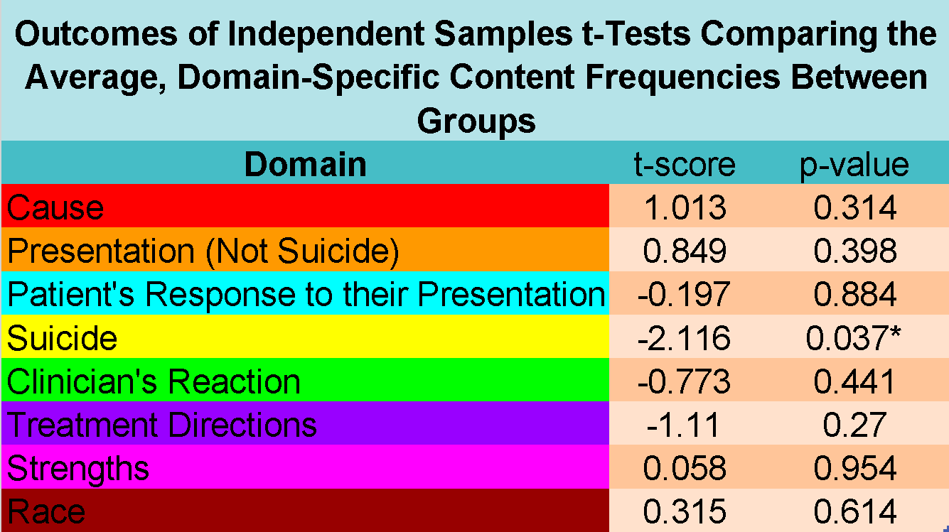
Statistical Analyses. Independent samples t-tests were conducted to compare the average frequency of each domain between both groups.
Results:
Conclusion:
-
Clinicians who interviewed a White virtual patient with suicidal risk had more content about suicide on average in their post-interview case conceptualizations compared to those of clinicians who interviewed a Black virtual patient with an identical clinical and response profile. This difference may demonstrate a race-based discrepancy in clinicians’ clinical perception of suicidal risk after they conduct an unstructured interview. Similar analyses at the subdomain level may uncover whether the type of suicide-related content also differs across groups.
-
Clinicians’ case conceptualizations did not differ between groups in content pertaining to the other seven domains, on average. However, cross-comparisons of average subdomain frequencies must be conducted to ensure that these results remain true at a more nuanced level.
References:
Barzilay, S., Schuck, A., Bloch‐Elkouby, S., Yaseen, Z. S., Hawes, M., Rosenfield, P., Foster, A., & Galynker, I. (2020). Associations between clinicians’ emotional responses, therapeutic alliance, and patient suicidal ideation. Depression and Anxiety, 37(3), 214–223. https://doi.org/10.1002/da.22973
Chen, M., Wang, X., Tan, D. S., Wang, H., Guo, J., Li, J., Zou, Z., Jiang, Y., & Liang, W. (2025). Tobacco and alcohol use; suicide ideation, plan, and attempt among adolescents; and the role of legal purchase age restrictions: A pooled population-based analysis from 58 countries. BMC Medicine, 23(1), 163. https://doi.org/10.1186/s12916-025-03983-6
Delphin-Rittmon, M. E., Flanagan, E. H., Andres-Hyman, R., Ortiz, J., Amer, M. M., & Davidson, L. (2015). Racial-ethnic differences in access, diagnosis, and outcomes in public-sector inpatient mental health treatment. Psychological Services, 12(2), 158–166. https://doi.org/10.1037/a0038858
Hill, C. E., Knox, S., Thompson, B. J., Williams, E. N., Hess, S. A., & Ladany, N. (2005). Consensual qualitative research: An update. Journal of Counseling Psychology, 52(2), 196–205. https://doi.org/10.1037/0022-0167.52.2.196
Miller, P. R. (2001). Inpatient diagnostic assessments: 2. Interrater reliability and outcomes of structured vs. unstructured interviews. Psychiatry Research, 105(3), 265–271. https://doi.org/10.1016/S0165-1781(01)00318-3
Mueller, A. E., & Segal, D. L. (2015). Structured versus Semistructured versus Unstructured Interviews. In R. L. Cautin & S. O. Lilienfeld (Eds.), The Encyclopedia of Clinical Psychology (1st ed., pp. 1–7). Wiley. https://doi.org/10.1002/9781118625392.wbecp069