
Wendy Guo’s Poster
Is Clinicians’ Emotion Regulation Related to Their Perception of the Therapeutic Alliance with High-Risk Virtual Patients ?
by Wendy Guo1,2, Jade Wei1,2, Anna Stephanie Prekas2, Amna Maryam1,2, Runqin Shi1,2,3, & Sarah Bloch-Elkouby2,3
1 Teachers College, Columbia University in the City of New York
2 Icahn School of Medicine at Mount Sinai in New York City
3 Ferkauf Graduate School of Psychology, Yeshiva University
Background:
Recent literature highlights the importance of establishing an effective therapeutic alliance when working with patients at high risk for suicide (Rudd et al., 2021; Fartacek et al., 2023), and the challenges that render this task difficult (Bloch-Elkouby & Barzilay, 2022). Among such challenges, therapists’ negative emotional responses were highlighted as key potential obstacles to a good alliance with high risk patients (Barzilay et al., 2020).
To date, the contribution of emotion regulation skills (trait) to therapists’ ability to establish and maintain an effective alliance with high-risk patients remains understudied.
This study’s aim was to fill this gap and examine whether clinicians’ emotion regulation skills predicts the quality of the therapeutic alliance and the occurrence of ruptures as experienced by clinicians. More specifically, this study strived to examine the relationship between four emotion regulation skills (ability to engage in goal-directed behavior, impulse control, emotion regulation strategies, and acceptance of emotional responses) and clinicians’ experience of the alliance and ruptures when working with a high-risk patient.
Hypothesis
Deficit in clinicians’ emotion regulation will be associated with clinicians’ experience of ruptures, such that clinicians with poorer emotion regulation skills will report more patient- and therapist- initiated ruptures.
Method
Procedure
This study analyzed archival data from 151 mental health professionals interacting with a virtual patients simulating high suicide risk. Half of the clinicians conducted a clinical interview with the Black version of the virtual patient, and half with the White version. Clinicians who provided inconsistent responses to a repeated item were excluded from the study.
Measures
- Difficulties in Emotion Regulation Scale (DERS) with subscales: Difficulties Engaging in Goal-Directed Behavior, Impulse Control Difficulties, Limited Access to Emotion Regulation Strategies, and Nonacceptance of Emotional Responses (Gratz & Roemer, 2004).
- The Rupture Resolution Rating System (3RS-SR) with subscales: Therapist-initiated Withdrawal, Therapist-initiated Confrontation, Patient-initiated Withdrawal, and Patient-initiated Confrontation (Eubanks et al., 2019).
Statistical Analysis
Pearson correlations were conducted. Bonferroni corrections were applied to the results in light of the multiple tests conducted. Data normality was assessed with via skewness/kurtosis and missing data handled by listwise deletion (Tabachnick & Fidell, 2019).
Results
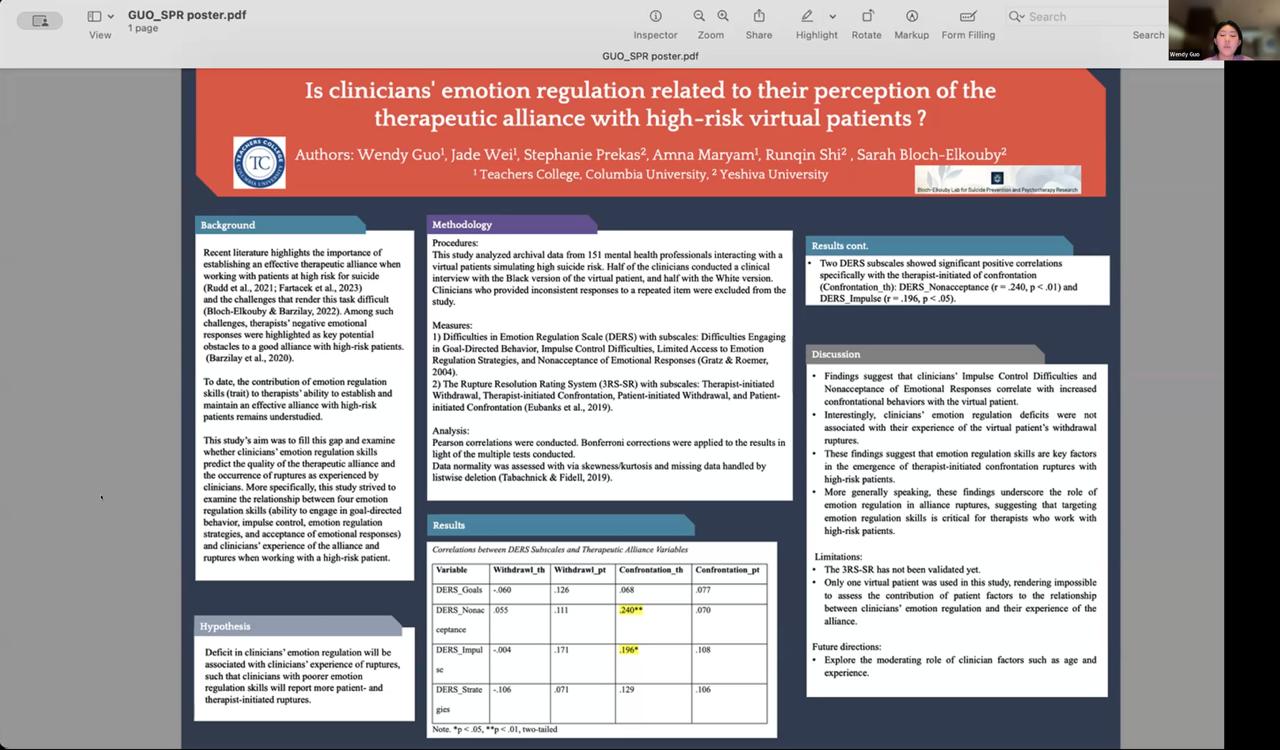
Two DERS subscales showed significant positive correlations specifically with the therapist-initiated of confrontation (Confrontation_th): DERS_Nonacceptance (r = .240, p < .01) and DERS_Impulse (r = .196, p < .05).
Discussion
- Findings suggest that clinicians’ Impulse control difficulties and Nonacceptance of emotional responses correlate with increased confrontational behaviors with the virtual patient.
- Interestingly, clinicians’ emotion regulation deficits were not associated with their experience of the virtual patient’s withdrawal ruptures.
- These findings suggest that emotion regulation skills are key factors in the emergence of therapist-initiated confrontation ruptures with high-risk patients.
- More generally speaking, these findings underscore the role of emotion regulation in alliance ruptures, suggesting that targeting emotion regulation skills is critical for therapists who work with high-risk patients.
Limitations
- The 3RS-SR has not been validated yet.
- Only one virtual patient was used in this study, rendering impossible to assess the contribution of patient factors to the relationship between clinicians’ emotion regulation and their experience of the alliance.
Future Directions
- Explore the moderating role of clinician factors such as age and experience.