
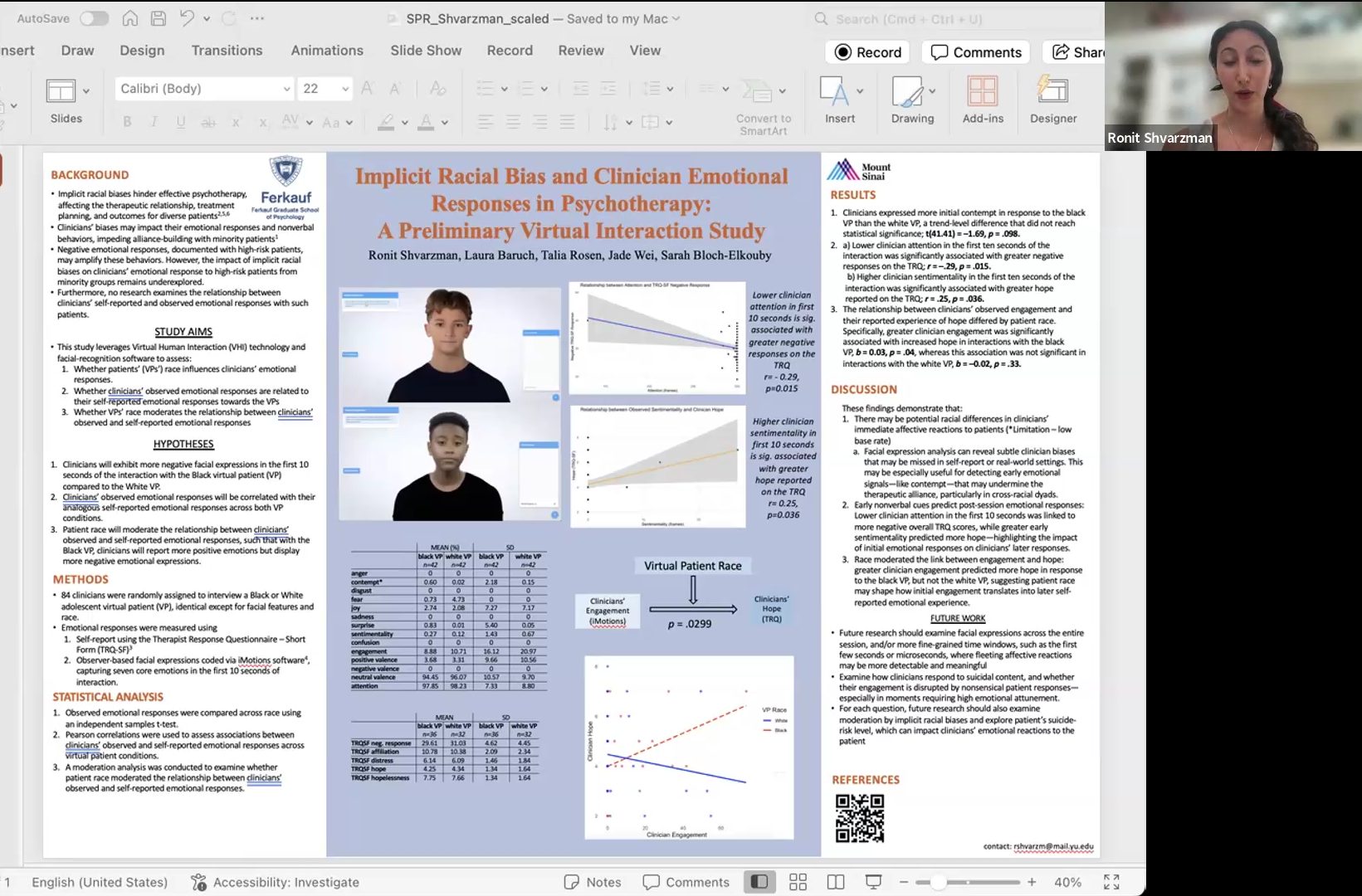
Ronit Shvarzman’s Poster
Implicit Racial Bias and Clinicians’ Observed Emotional Responses in Psychotherapy: A Virtual Interaction Study
by Ronit Shvarzman1, Laura Baruch1, Talia Rosen1, Jade Wei2,3, & Sarah Bloch-Elkouby1,2
1 Ferkauf Graduate School of Psychology, Yeshiva University
2 Icahn School of Medicine at Mount Sinai in New York City
3 Teachers College, Columbia University in the City of New York
Background:
- Implicit racial biases hinder effective psychotherapy, affecting the therapeutic relationship, treatment planning, and outcomes for diverse patients. 2,5,6
- Clinicians’ biases may impact their emotional responses and nonverbal behaviors, impeding alliance-building with minority patients.1
- Negative emotional responses, documented with high-risk patients, may amplify these behaviors. However, the impact of implicit racial biases on clinicians’ emotional response to high-risk patients from minority groups remains underexplored.
- Furthermore, no research examines the relationship between clinicians’ self-reported and observed emotional responses with such patients.
Study Aims:
This study leverages Virtual Human Interaction (VHI) technology and facial-recognition software to assess:
- Whether patients’ (VPs’) race influences clinicians’ emotional responses
- Whether clinicians’ observed emotional responses are related to their self-reported emotional responses towards the VPs
- Whether VPs’ race moderates the relationship between clinicians’ observed and self-reported emotional responses
Hypotheses:
- Clinicians will exhibit more negative facial expressions in the first 10 seconds of the interaction with the Black virtual patient (VP) compared to the White VP.
- Clinicians’ observed emotional responses will be correlated with their analogous self-reported emotional responses across both VP conditions.
- Patient race will moderate the relationship between clinicians’ observed and self-reported emotional responses, such that with the Black VP, clinicians will report more positive emotions but display more negative emotional expressions.
Method:
84 clinicians were randomly assigned to interview a Black or White adolescent virtual patient (VP), identical except for facial features and race. Emotional responses were measured using
- Self-report using the Therapist Response Questionnaire – Short Form (TRQ-SF)3
- Observer-based facial expressions coded via iMotions software4, capturing seven core emotions in the first 10 seconds of interaction.
Statistical Analysis:
- Observed emotional responses were compared across race using an independent samples t-test.
- Pearson correlations were used to assess associations between clinicians’ observed and self-reported emotional responses across virtual patient conditions.
- A moderation analysis was conducted to examine whether patient race moderated the relationship between clinicians’ observed and self-reported emotional responses.
Results:
- Clinicians expressed more initial contempt in response to the black VP than the white VP, a trend-level difference that did not reach statistical significance; t(41.41) = –1.69, p = .098.
- (a) Lower clinician attention in the first ten seconds of the interaction was significantly associated with greater negative responses on the TRQ; r = –.29, p = .015. (b) Higher clinician sentimentality in the first ten seconds of the interaction was significantly associated with greater hope reported on the TRQ; r = .25, p = .036.
- The relationship between clinicians’ observed engagement and their reported experience of hope differed by patient race. Specifically, greater clinician engagement was significantly associated with increased hope in interactions with the black VP, b = 0.03, p = .04, whereas this association was not significant in interactions with the white VP, b = –0.02, p = .33.
Conclusion:
These findings demonstrate that:
- There may be potential racial differences in clinicians’ immediate affective reactions to patients (*Limitation – low base rate) (a) Facial expression analysis can reveal subtle clinician biases that may be missed in self-report or real-world settings. This may be especially useful for detecting early emotional signals—like contempt—that may undermine the therapeutic alliance, particularly in cross-racial dyads.
- Early nonverbal cues predict post-session emotional responses: Lower clinician attention in the first 10 seconds was linked to more negative overall TRQ scores, while greater early sentimentality predicted more hope—highlighting the impact of initial emotional responses on clinicians’ later responses.
- Race moderated the link between engagement and hope: greater clinician engagement predicted more hope in response to the black VP, but not the white VP, suggesting patient race may shape how initial engagement translates into later self-reported emotional experience.
Future Directions:
- Future research should examine facial expressions across the entire session, and/or more fine-grained time windows, such as the first few seconds or microseconds, where fleeting affective reactions may be more detectable and meaningful
- Examine how clinicians respond to suicidal content, and whether their engagement is disrupted by nonsensical patient responses—especially in moments requiring high emotional attunement.
- For each question, future research should also examine moderation by implicit racial biases and explore patient’s suicide-risk level, which can impact clinicians’ emotional reactions to the patient
References:
1. Benjamin, L. S. (1974). Structural Analysis of Social Behavior. Psychological Review, 81 , 392 425.
2. Eubanks, C. F., Lubitz, J., Muran, J. C., & Safran, J. D. (2019). Rupture Resolution Rating System (3RS): Development and validation. Psychotherapy research : journal of the Society for Psychotherapy Research, 29(3), 306–319. https://doi.org/10.1080/10503307.2018.1552034
3. Pasquali, C. E., Ybrandt, H., & Armelius, K. (2018). Client self-image, therapist acting, and the establishment of the therapeutic alliance in a training context. European Journal of Psychotherapy & Counselling, 20(4), 373–390. https://doi.org/10.1080/13642537.2018.1529687
4. Ryum, T., Vogel, P. A., Walderhaug, E. P., & Stiles, T. C. (2015). The role of self‐image as a predictor of psychotherapy outcome. Scandinavian Journal of Psychology, 56(1), 62–68. https://doi.org/10.1111/sjop.12167
5. Silverstone, P. H., & Salsali, M. (2003). Low self-esteem and psychiatric patients: Part I – The relationship between low self-esteem and psychiatric diagnosis. Annals of General Psychiatry, 2(1), 2. https://doi.org/10.1186/1475-2832-2-2